Don't have an account?
 1800-102-2977
Innova™ IGS 540 is a floor-mounted system that boasts one of the largest fields of view for interventional oncology procedures.


See. Your Way. Clearly.
With its 41 cm (16.1 in) square detector, Innova IGS 540 provides extensive body coverage for peripheral and abdominal procedures.
The Innova IGS 540 was designed from the ground up to provide the image clarity you need while helping you keep dose as low as possible. It includes features like Dose Personalization1, which gives you the tools to choose from up to five2 automatic exposure preferences for your system. You can also modify any of these preferences in any clinical protocol, to enable multi-procedure, multi-user customization, and thus support well-informed decisions.
Powered with dedicated advanced applications, you can plan, guide and assess procedures with confidence.
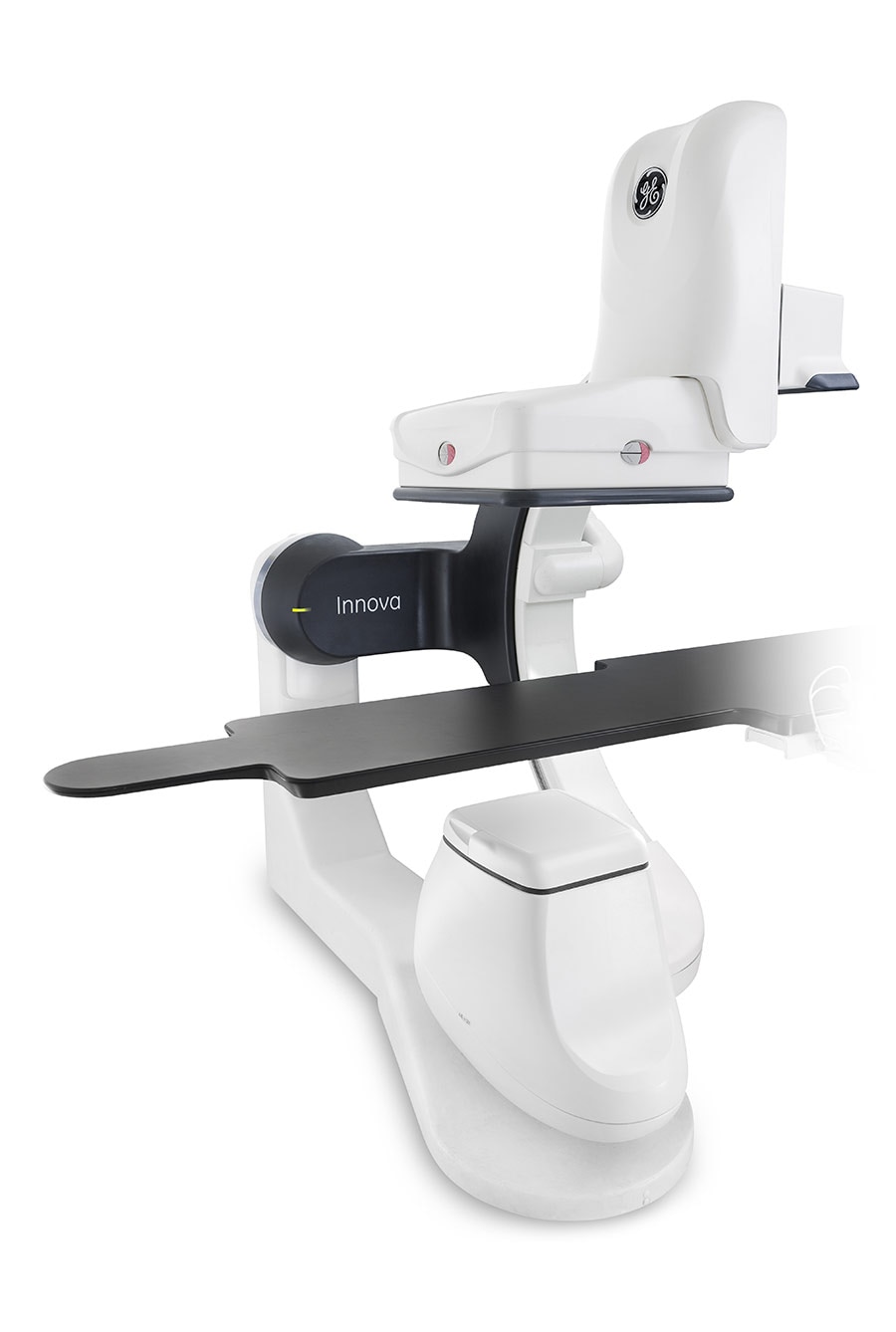
The Innova IGS 540 with its 41 x 41 cm (16.1 in) square flat-panel digital detector boasts one of the largest fields of view for vascular and interventional imaging. It can cover large anatomies, such as both legs simultaneously, designed for fewer runs than smaller detectors, enabling efficient use of contrast and dose.

The proprietary angiography flat-panel detector offers one of the industry’s highest ratings for Detective Quantum Efficiency (DQE), a parameter internationally acknowledged as an index of detector performance in contrast- and dose-limited imaging performed in clinical studies. High DQE enables better-quality images at the same dose, or the same quality image at a lower dose.

GE designs systems from the ground up with the tried and trusted GE imaging chain, optimized to provide the image clarity you need while keeping dose as low as possible. Our dose-reduction features empower you to easily optimize and personalize dose settings from the tableside, while maintaining clinical details you need to make well-informed decisions. But improving dose management takes a strategy – what we call the GE Blueprint. It includes low-dose imaging technologies for minimally invasive procedures, but also considers the people, culture and processes around them.
Learn more.

Control your system and images with integrated, intuitive tableside controls. With simple menus, the Central touchscreen lets you control most system functions, configure the system, modify imaging parameters, control your large display monitor, and manipulate advanced applications – all at the tableside. The comfortable, easy-to-grasp control knob makes it easy to pan the table, position the gantry, and perform procedures.

The full-color 142 cm (56 in) diagonal 8 megapixel medical-grade large display lets you view multiple images from multiple sources. Get up to 120 customized layouts, easily changeable at tableside with the Central touchscreen. Zoom in comfortably without loss of detail or pixilation to get the clinical focus you need.

Over 20 advanced applications to help you plan, guide and assess complex procedures
GE Healthcare offers a full suite of advanced applications designed to help improve your lab efficiency and enhance clinical confidence to plan, guide and assess complex procedures. They can be used across a full range of interventional procedures whilst being built to answer dedicated challenges. Example of a brilliant innovation in Interventional oncology is FlightPlan for Liver that helps plan TACE procedures by automatically highlighting vessels traveling from the catheter tip to the hypervascular lesion.


Liver embolization
To deliver therapeutic material to tumors during trans-arterial chemoembolization therapy, it is essential to identify the liver vessels accurately. But the liver's complex vasculature can make precise identification of tumor-feeding vessels in 2D and 3D images a challenge, often requiring significant time, radiation, and contrast media.


Our clinical applications training helps to ensure that you are utilizing your GE interventional imaging and invasive systems at their maximum performance and getting the most from the investment you've made. A knowledgeable staff of highly trained Clinical Applications Specialists will help you set-up and use your GE systems.
In clinical use, the results of the application of dose reduction techniques will vary depending on the clinical task, patient size, anatomical location and clinical practice. The Interventional radiologist, assisted by a physicist as necessary has to determine the appropriate settings for each specific clinical task.
1 – Option
2 – Except in following countries: Germany, Switzerland, Austria, New Zealand where that list is limited to 3 preferences
3 - For XA modality series, Integrated Registration currently supports only 3D X-Ray angiography images (stored as CT Image Storage DICOM objects) acquired with GE equipment and reconstructed with the 3DXR application.

