
• Change country/language

    Looks like you’re in {} — you’re on the {} site.

    Cancel

    Country and language selected

    You are being redirected to the {} site. Products and services availability vary by country. Do you wish to continue?

    Continue
    Cancel

Lung Protection Ventilation

Lung1

Applying intraoperative lung protective ventilation1

Globally, more than 200 million patients undergo general anaesthesia and receive mechanical ventilation every year. Overall, General anaesthesia is an effective method for enabling surgical procedures. Mechanical ventilation is an essential support during general anaesthesia, but sometimes it may contribute to impaired respiratory function.

Protective ventilation strategies have been used in critical care medicine and can be translated to the operating room with the aim of improving postoperative outcomes. Growing evidence suggests that prophylactic lung protective ventilation strategies, using low tidal volumes, individualized positive end expiratory pressure (PEEP) and recruitment manoeuvres (RMs) as appropriate, can minimize the incidence of postoperative pulmonary complications (PPCs).¹

1Futier E, et al. A trial of intraoperative low-tidal-volume ventilation in abdominal surgery. New England Journal of Medicine. 2013; 369(5): 428-437.
https://www.nejm.org/doi/full/10.1056/NEJMoa1301082

Vital Capacity and Cycling

It is well known that atelectasis occurs during general anaesthesia and can persist postoperatively, contributing to significant post-operative complications with additional healthcare costs.2

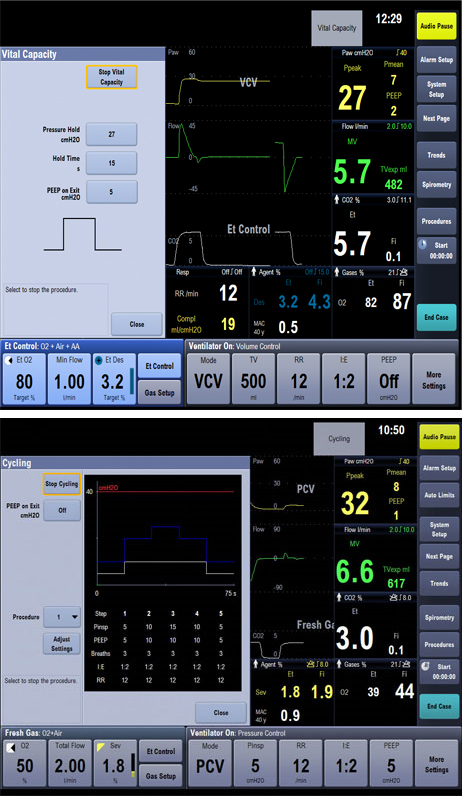
Recruitment maneuvers (RMs) are intended to open collapsed alveoli by applying transient increases in transpulmonary pressure. Until now, this has been delivered manually by the caregiver during the case. The Aisys CS2 and Avance CS2 Carestations introduce two lung ventilation procedures to help caregivers in dealing with atelectasis.

Vital Capacity procedure automates the manual bag ‘squeeze and hold.' PEEP can be programmed at the end of the procedure thus helping to prevent derecruitment.

Cycling is a tool that allows the clinician to design a lung mechanics manoeuvre, to stepwise increase and decrease PEEP in programmable increments or decrements, during mechanical ventilation, with the aim of helping the clinician reopen the alveoli and keep them open.

2. Magnusson L, Spahn DR. New concepts of atelectasis during general anaesthesia. Br J Anaesth. 2003; 91(1): 61-72.

https://academic.oup.com/bja/article/91/1/61/276054

Lung protection during surgery: current evidence and practice recommendations

Duke University Medical Centre and GE Healthcare have setup an expert group which discussed current evidence and practice recommendations for Lung protection during surgery. Listen to Christopher Young (Durham, NC, USA) for the introduction and overview on a recent symposium during ESA 2019 in Vienna.

Lung Protection at case set up/induction of anaesthesia

Listen to Emmanuel Futier (Clermont-Ferrand, France) talking about Lung Protection at case set up/induction of anaesthesia.

Lung Protection during maintenance of anaesthesia

Listen to Paolo Pelosi (Genova, Italy) talking about Lung Protection during maintenance of anaesthesia.

Lung Protection on emergence from anaesthesia

Listen to Marcelo Gama de Abreu (Dresden, Germany) talking about Lung Protection on emergence from anaesthesia.

Download

Lung Protective Ventilation
JB00806AFG May 2023