• Change country/language

    Looks like you’re in {} — you’re on the {} site.

    Cancel

    Country and language selected

    You are being redirected to the {} site. Products and services availability vary by country. Do you wish to continue?

    Continue
    Cancel

Introducing NM/CT 870 CZT, our third-generation, general purpose SPECT/CT system powered by CZT technology. It combines improvements in lesion detection1, image quality and patient comfort with advanced quantitative applications provided through Xeleris™. This latest generation offers an all-new SmartConsole and new CT features. Help bring your theories to life with a system designed to leverage all that CZT can do.


GEHC870CZTTechnologyImage1v1
TECHNOLOGY

SPECT/CT as you have never seen it before

CZT is the key component to the future of nuclear medicine. Not only is it lighter and more compact than the Nal crystals used in analog technology, it is pixelated. Each detector head consists of 130 CZT detector modules, which means there are tens of thousands of tiny 2.46 mm-sized pixels capturing events independently, all via direct conversion. With CZT and registered collimation, each photon is directly converted into an electrical signal that more accurately identifies its location and energy. This design reduces the signal loss and noise inherent in conventional SPECT detection by eliminating gamma photon conversion through scintillation and light conversion through PMT. The result is increased spatial and energy resolution.


NM/CT 870 CZT is the third-generation of our general purpose digital SPECT/CT system designed with this breakthrough CZT detection technology. Combined with the latest Xeleris quantitative applications and CT advancements that include a 32-slice overlapped reconstruction capability, the latest dose reduction technologies and Smart MAR, this system will transform your entire nuclear medicine experience.


  •  Up to 75 percent reduction in injected dose or scan time 2
  •  Improved system spatial resolution, from 4.3 mm to 2.8 mm 3
  •  Exceptional energy resolution, 6.3 percent compared to 9.5 percent
  •  Greater than 40 percent improvement in SPECT contrast-to-noise   ratio 4
  •  67 percent reduction in detector frame size, from 7.5 cm to 2.5 cm
  •  25 percent greater optimal FOV than Nal
  •  1.4 times higher count rates than conventional technology
  •  Up to 50 percent reduction in injected dose or scan time with   Evolution technology 5
  •  Leverage advanced CT dose reduction technology with ASiR™ ,6
  •  Maintain quantitative SPECT accuracy when corrected by low-dose CT with Q.AC 7
  • Smart MAR helps reduce photon starvation, beam hardening and streak artifacts caused by metal in the body, such as hip implants
  • Platform compatible with advanced digital solutions designed to connect machines, people and data throughout a portfolio of healthcare analytics applications
GEHC870CZTResolutionImage1v1
RESOLUTION

The resolution to discover something new

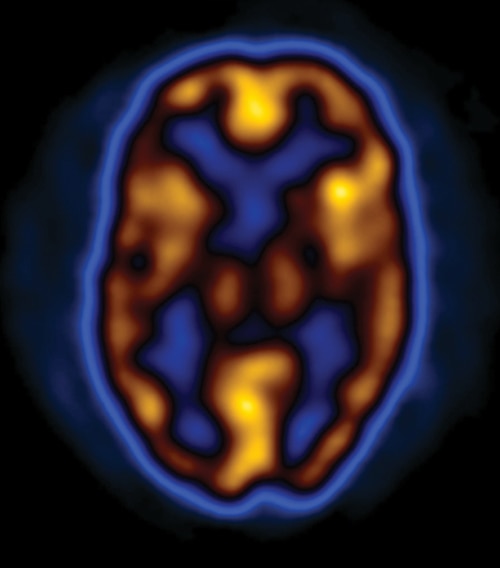
As molecular imaging continues to move toward the development of disease-specific diagnoses and increasingly personalized care, resolution is important. Early disease detection is only possible with a high system resolution that enables visualization of finer anatomic detail. In addition, research with multi-isotope exams requires precise energy resolution to reduce spillover between tracers. NM/CT 870 CZT has a 6.3 percent energy resolution and the ability to detect the energy from multiple tracers with more definition, making it possible to explore new protocols with the variety of SPECT tracers available.

Features

Discover new protocols enabling differential diagnosis by visualizing multiple tracers simultaneously

Push nuclear medicine’s boundaries by developing new diagnostic services

Pursue opportunities for tracer development and better utilization of currently available tracers

Continue your efforts to diagnose and stage disease earlier with smaller lesion detectability1

See everything clearly now


With direct conversion detection, NM/CT 870 CZT has substantially improved system resolution by eliminating the signal loss and noise that comes with analog detection technology. It also uses a registered collimation design that aligns each collimator hole with a single detector pixel. This design eliminates the impact of collimator resolution that would normally affect the overall system resolution. The result is an improved contrast-to-noise ratio and spatial resolution down to 2.8 mm3.


Features

More accurately assess treatment response to guide your treatment planning decisions with increased quantitation accuracy8


Grow patient volumes from referring physicians that value accurate, reproducible results and the diagnostic confidence you deliver


Increase patient satisfaction by reducing compromised exams that result in repeat scans

GEHC870CZTDesignImage1v1
DESIGN

Designed to make every inch count

Just like the transition from analog to digital technology in other industries, the technology required to create a digital image is lighter, and more compact, with fewer constraints on system design. Using registered collimation, NM/CT 870 CZT contains detected events entirely within a single pixel aligned to one collimator hole, even at the outermost edges of the FOV. This reduction in dead space enables a system design that can get closer to anatomies and increase patient comfort.


A patient-centric detector design with 67 percent reduction in brain reach makes certain exams more tolerable. Normally, cardiac SPECT scans require patients to extend and hold their arms above their head for a long duration. With NM/CT 870 CZT, that scan time may be reduced by up to 75 percent2

and the near frameless detector design can enable patients to hold their arms at a more comfortable angle.

Features

Improve imaging results by scanning in closer proximity to your patients

Provide more tolerable exams for greater patient comfort

Conventional technology at 20 cm radius.

NM/CT 870 CZT at 14 cm radius.

GEHC870CZTQuantitationImage1v1
QUANTITATION

Quantitative SPECT/CT for every patient, every day

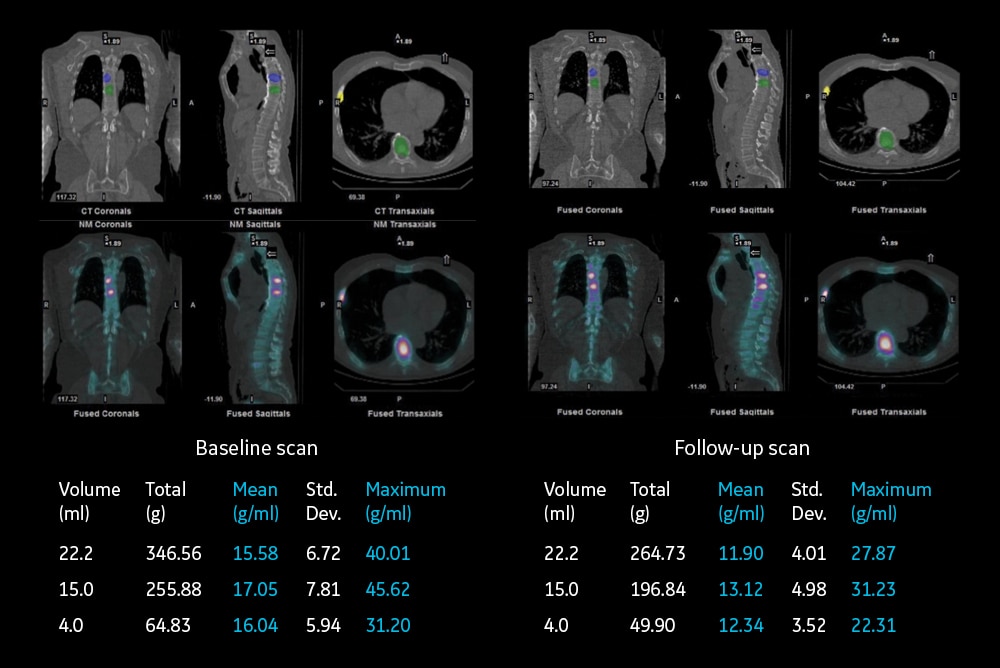
To lead clinical discovery with hybrid imaging, you need quantitation. It’s what makes it possible to not only find disease, but to follow its response to treatment over time. It helped establish PET/CT as a valuable clinical tool. Now, with recent advancements to technology, consistent and accurate quantitation is possible with SPECT/CT.

Features

Guide therapy planning decisions with quantitative disease state and treatment response assessment

Grow patient volumes with referring physicians that value accurate, reproducible results and the diagnostic confidence you deliver

Built for quantitation

NM/CT 870 CZT is a SPECT/CT built for consistent, reproducible quantitation. The improvements to detector performance that you get with CZT enable exceptional spatial and energy resolution compared to Nal detectors. It also leverages CT-based attenuation and scatter correction along with Evolution5


image reconstruction. In addition, ever-increasing computational power enables precise camera calibration for less variation between exams.

Once your quantitative studies are acquired, the new SmartConsole, together with Xeleris, makes it easier to access them. With SmartConsole, your quantitative SPECT/CT studies are automatically transferred directly to the PACS or other pre-defined DICOM destinations. Furthermore, an additional dataset in PET DICOM format allows you to review and evaluate images on the same devices you use to view your PET/CT studies, as adjacent information to the original SPECT/CT images.

GEHC870CZTQuantitativeApplicationsImage1v1
QUANTITATIVE APPLICATIONS

Inform your decisions with measurable results

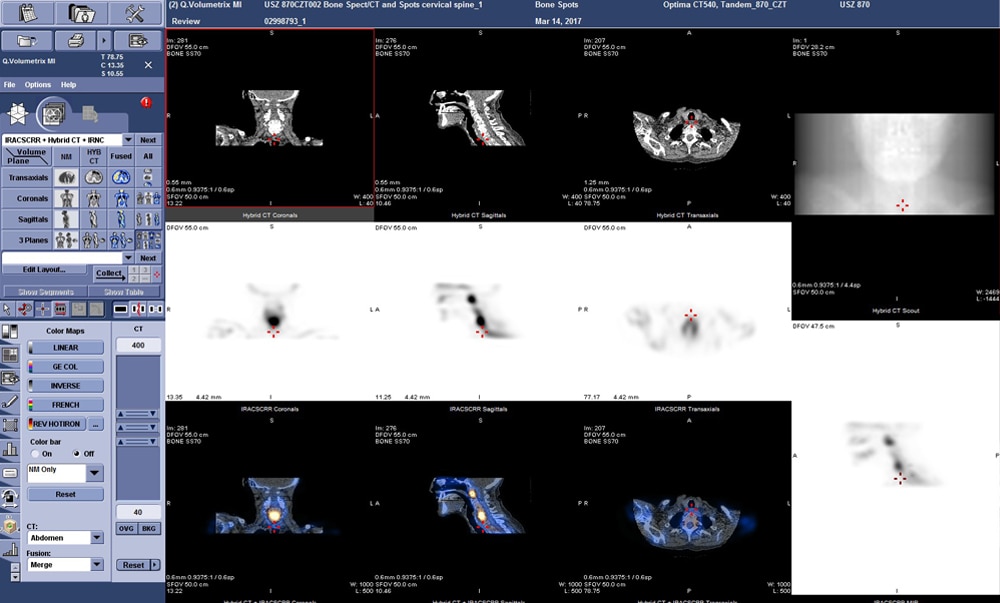
The Xeleris workstation is our Nuclear Medicine, PET, NM/CT and PET/CT processing, analysis and review system. It’s designed to leverage the latest in SPECT quantitative applications for routine clinical use, accelerate workflow and improve diagnostic confidence. It also opens the door to the new era of digital healthcare delivery through its potential to access the GE Health Cloud and with advanced applications to help solve some of the most complex clinical presentations.

GEHC870CZTSummaryImage1v1
SUMMARY

A SPECT/CT system for true discovery

Molecular imaging enables the search for a different kind of discovery. The kind that could have a lasting impact on the world. A true discovery. Not only is it proof of a new way to understand something hidden deep within us, it has the ability to transcend the individual to make a greater impact on all patients.


The search for true discovery is unique. It requires the right balance of technology and people. The technology to enable the search and the people to embrace it. We have worked with leaders in healthcare like you to understand what obstacles stand in your way and what solutions you seek.

NM/CT 870 CZT is the result of these partnerships. We hope you see it as we do. Not as another imaging product, but as a tool to help you bring your theories to life.

FOOTNOTES

  • 1 In clinical practice, the use of NM/CT 870 CZT may improve lesion detectability depending on the clinical task, patient size, anatomical location and clinical practice. A consultation with a radiologist and a physicist should be made to determine the appropriate dose or scan time to obtain diagnostic image quality for the particular clinical task.
  • 2 Together with Clarity 2D and Evolution 5 and compared to Discovery NM/CT 670 Pro/ES/DR without Clarity 2D and Evolution 5 . As demonstrated in phantom testing using a bone scan protocol, and the NEMA IEC Body Phantom. The actual time/dose reduction depends on the clinical task, patient size, anatomical location and clinical practice.
  • 3 At detector surface.
  • 4 Demonstrated in phantom testing using NEMA IEC Body Phantom at 50% scan times with Evolution 5 . Compared to Discovery NM/CT 670 Pro/ES/DR.
  • 5 In clinical practice, Evolution options 5a (Evolution for Bone, Evolution for Cardiac, Evolution for Bone Planar) and Evolution Toolkit 5b are recommended for use following consultation of a Nuclear Medicine physician, physicist and/or application specialist to determine the appropriate dose or scan time reduction to obtain diagnostic image quality for a particular clinical task, depending on the protocol adopted by the clinical site.
  • 5a Evolution Options - Evolution claims are supported by simulation of count statistics using default factory protocols and imaging of 99mTc based radiotracers with LEHR collimator on anthropomorphic phantom or realistic NCAT – SIMSET phantom followed by quantitative and qualitative images comparison.
  • 5b Evolution Toolkit - Evolution Toolkit claims are supported by simulation of full count statistics using lesion simulation phantom images based on various radiotracers and collimators and by showing that SPECT image quality reconstructed with Evolution Toolkit provide equivalent clinical information but have better signal-to-noise, contrast, and lesion resolution compared to the images reconstructed with FBP / OSEM.
  • 6 In clinical practice, the use of ASiR may reduce CT patient dose depending on the clinical task, patient size, anatomical location and clinical practice. A consultation with a radiologist and a physicist should be made to determine the appropriate dose to obtain diagnostic image quality for the particular clinical task.
  • 7 Quantitative accuracy defined as equivalence to well counter-measured injected activity in a test phantom. Equivalence means <11% difference when comparing measured counts in SPECT studies corrected by Q.AC-reconstructed CTAC to measured counts in studies corrected by benchmark reconstructed CTAC. Measured counts are defined as average within identical ROIs positioned on SPECT reconstructed slices of homogenous 99mTc solution phantom study.
  • 8 In clinical practice, the use of NM/CT 870 CZT may improve quantitation of lesions larger than 5.5 mL, depending on the clinical task, patient size, anatomical location and clinical practice. A consultation with a radiologist and a physicist should be made to determine the appropriate dose or scan time to obtain the claimed quantitation accuracy for the particular clinical task.
JB00367CA May 2021